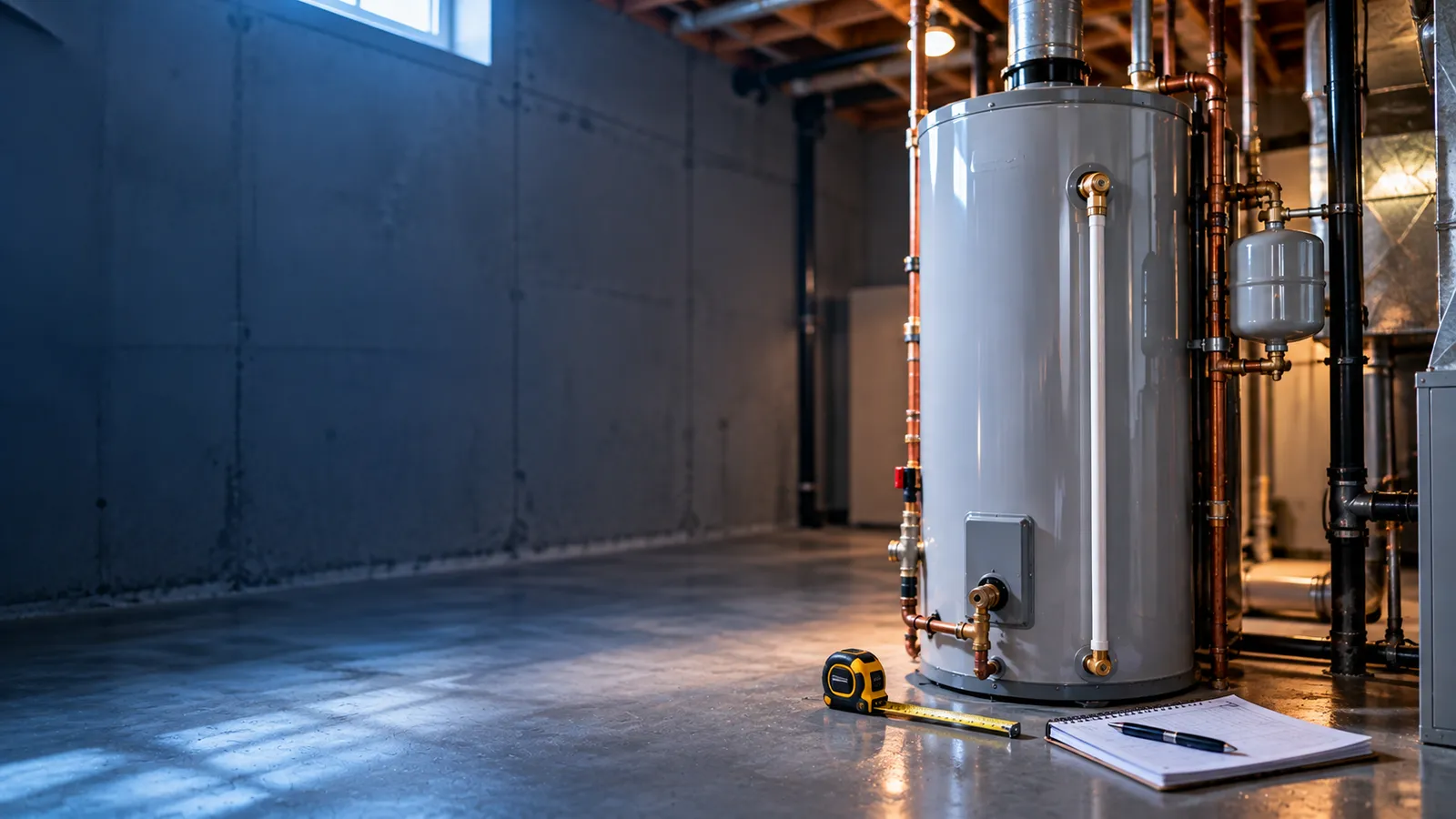
What size hot water tank do I need? The right size depends on how much hot water your household uses in its busiest hour, not only on how many people live in the house. As a starting point, H2O Expert Plumbing’s hot water tank page says a 40-gallon tank is usually enough for 1 to 2 people, 50 gallons suits 3 to 4 people, and larger households may need 60 gallons or more, or a tankless system. To check that rule against your own habits, compare your peak-hour demand with a tank’s first-hour rating, which this guide walks through step by step.
- Household size gives a rough tank size; peak-hour use gives a better one.
- The first-hour rating (FHR) is the number to compare, and it should be at or just above your busiest-hour demand.
- Tankless units are sized by flow rate and temperature rise, not by tank gallons.
- A bigger tank, or a different type, can change gas, venting and electrical needs, which are work for licensed trades.
In this article
- How big a hot water tank does my household need?
- Why isn’t tank size the whole answer?
- How do I size a hot water tank, step by step?
- Which size fits which household, in practice?
- How do I size a tankless water heater?
- What are the most common sizing mistakes?
- What changes when I go up a size or switch type?
- What should I bring to a sizing conversation?
- Your next step
- Frequently asked questions
How big a hot water tank does my household need?
Start with the rule of thumb on the company’s own service page. For 1 to 2 people, a 40-gallon tank is usually sufficient; 3 to 4 people typically need 50 gallons; and larger households may need 60 gallons or more, or a tankless system.
| Household | Typical starting size (per the company’s hot water tank page) |
|---|---|
| 1 to 2 people | 40 gallons |
| 3 to 4 people | 50 gallons |
| Larger households | 60+ gallons, or a tankless system |
Treat that table as a starting point. Natural Resources Canada says the average Canadian household uses about 75 litres of hot water per day, but an average is spread across a whole day. What empties a tank is a short, busy window, such as three morning showers and a dishwasher cycle in the same hour.
Why isn’t tank size the whole answer?
Two tanks with the same label size can behave differently, because the number that matters is how much hot water the unit can supply in an hour. ENERGY STAR defines the first-hour rating as an estimate of how much hot water a storage water heater can supply in one hour, starting from a fully heated tank. Its test measures that at a 125°F outlet temperature.
The U.S. Department of Energy’s Building America program describes gas storage tanks as delivering hot water immediately, with good recovery capacity, and electric tanks with moderate recovery capacity. Recovery is how fast the unit reheats after you draw water, so two 50-gallon tanks can differ in what they deliver across a busy hour. That is why a first-hour rating is a better comparison than gallons alone.
How do I size a hot water tank, step by step?
This method follows the approach in the Building America Solution Center’s first-hour rating tool, which says its method is based on guidance from the Air-Conditioning, Heating and Refrigeration Institute (AHRI).
- Find your busiest hour. Think about when the most people use hot water at once, usually a weekday morning or an evening with laundry and baths.
- List every hot water use in that hour. Include showers, baths, the dishwasher, the clothes washer and kitchen sinks.
- Estimate the gallons for each use and add them up. Use a published worksheet, such as the one built into the Building America tool, rather than guessing. The tool recommends using the high-end value for each use so the heater still serves the household over its average 13-year life.
- Read the first-hour rating on the unit. Save on Energy, an Ontario program, tells shoppers to check the FHR on the tank label.
- Match the rating to your demand. The Building America tool says to select a storage water heater with a first-hour rating equal to or greater than your peak-hour demand, and Save on Energy suggests aiming within 1 to 2 gallons of it. Read together, that means at or just above your number, not far above it.
- Check the practical limits. Confirm the fuel type, the venting path and the space available before you commit to a model.
An illustration with made-up round numbers: if your worksheet comes to 60 gallons for the busiest hour, you would look for a unit with a first-hour rating of 60 or more. The label size on the tank is secondary to that rating.
Which size fits which household, in practice?
The rule of thumb and the peak-hour method can disagree, and that is useful information. A two-person household that runs the dishwasher and a long shower at the same time every morning may need more than the 40-gallon starting point. A four-person household that staggers its use may be fine with a 50.
Three habits push demand up:
- Several people showering back to back.
- A soaker tub or a large clothes-washer load in the same hour as showers.
- A new use, such as a home addition, that the old tank was never sized for.
If you are replacing an old tank, ask whether it ever ran out. A tank that did not run out is a useful data point, and one that did is a clear sign to move up.
How do I size a tankless water heater?
A tankless unit has no stored water, so gallons do not apply. The U.S. Department of Energy’s Building Science Education Solution Center says tankless sizing should be based on the practical maximum flow rate needed at one time and the heat rise, and that heat rise depends on the winter cold-water temperature and the hot water setpoint.
In practice, that means two questions. How many outlets could run at once, and how cold is the incoming water on a January morning? Colder incoming water means the unit has to add more heat to hit the same setpoint.
Natural Resources Canada warns that a tankless unit’s output may be exceeded by simultaneous high demand, such as several showers at once. For the full comparison, see our guide to tankless vs tank water heaters in Calgary.
What are the most common sizing mistakes?
Sizing by headcount alone. Two households of four can have very different peak hours.
Copying the old tank without asking why. The old size reflects the household of the day it was installed. Habits, family size and fixtures change.
Assuming bigger is always safer. Natural Resources Canada notes that a storage tank keeps using energy even when no hot water is drawn. A tank much larger than you need still has to be kept hot.
Ignoring simultaneous use on a tankless unit. The unit can be correctly sized for one shower and still struggle with two.
Forgetting what a size or type change can trigger. Moving up a size is not always a like-for-like swap, as the next section explains.
What changes when I go up a size or switch type?
A larger tank may not fit the same space, and a different type may need different venting or a larger gas supply. The Department of Energy’s guideline rates the retrofit installed cost of a gas tankless unit as high, assuming the gas line must be upsized. The Building Science Education Solution Center adds that sealed-combustion, direct-vent or power-vented equipment must be used in cold climates, which includes Calgary winters.
Some of these changes also matter for permits. The City of Calgary says replacing a hot water tank may require a permit in some cases, including changes to the gas lines upstream of the water heater shut-off valve, to the venting system, or to the type of water heater. Our explainer on whether Calgary requires a permit to replace a hot water tank covers what the City says. Gas, venting and permit work is for licensed professionals, not a weekend project.
What should I bring to a sizing conversation?
A short list makes a quote far more accurate:
- The number of people in the home and when they use hot water.
- The make, size, fuel type and age shown on your current tank’s label.
- Any history of running out of hot water, or of the tank being too slow to recover.
- Photos of the tank, its venting and the space around it.
- Any plans that will change demand, such as a renovation or a new bathroom.
The company lists tank sizing consultation among its hot water tank services and says you receive a written quote before work begins. If the cost question is next on your list, read how much a hot water tank costs in Calgary.
Your next step
Work out your busiest hour, write down the first-hour rating you are aiming for, and bring both to a licensed plumber who can check them against your fuel type, venting and space. If you would like a sizing conversation, you can get a free quote or call +1 (403) 700-4443. The company is available 7 days a week. The company describes its team as licensed plumbing and gas-fitting professionals in Calgary, and its services list includes gas line hook-ups and plumbing and gas permits.
Frequently asked questions
How many gallons of hot water tank do I need per person?
There is no exact per-person figure. H2O Expert Plumbing’s hot water tank page gives a rule of thumb: 40 gallons for 1 to 2 people, 50 gallons for 3 to 4 people, and 60 gallons or more, or tankless, for larger households. Your busiest hour matters more than headcount, so use the first-hour rating method above to check.
What is a first-hour rating?
The first-hour rating is an estimate of how much hot water a storage water heater can supply in one hour, starting with a fully heated tank, according to ENERGY STAR. It is the figure to compare against your busiest-hour demand. You can find it on the unit’s label or the manufacturer’s literature.
Is a bigger hot water tank better?
Not automatically. A tank that is too small runs out of hot water, but a tank much larger than you need still has to be kept hot, and Natural Resources Canada notes that storage tanks use energy even when no hot water is drawn. Aim for a first-hour rating at or just above your peak-hour demand.
How do I size a tankless water heater?
Tankless units are sized by the maximum flow you need at one time and the temperature rise required, which depends on your winter cold-water temperature and your hot water setpoint. Add up the outlets that could run together and ask a licensed plumber to confirm the unit can keep up.
Can I switch from a tank to a tankless water heater?
Often, but it can involve more than swapping the unit. A gas tankless water heater may need a larger gas line and different venting, and the City of Calgary says changes to venting, gas lines or the type of water heater can require a permit. A licensed professional should assess your home first.