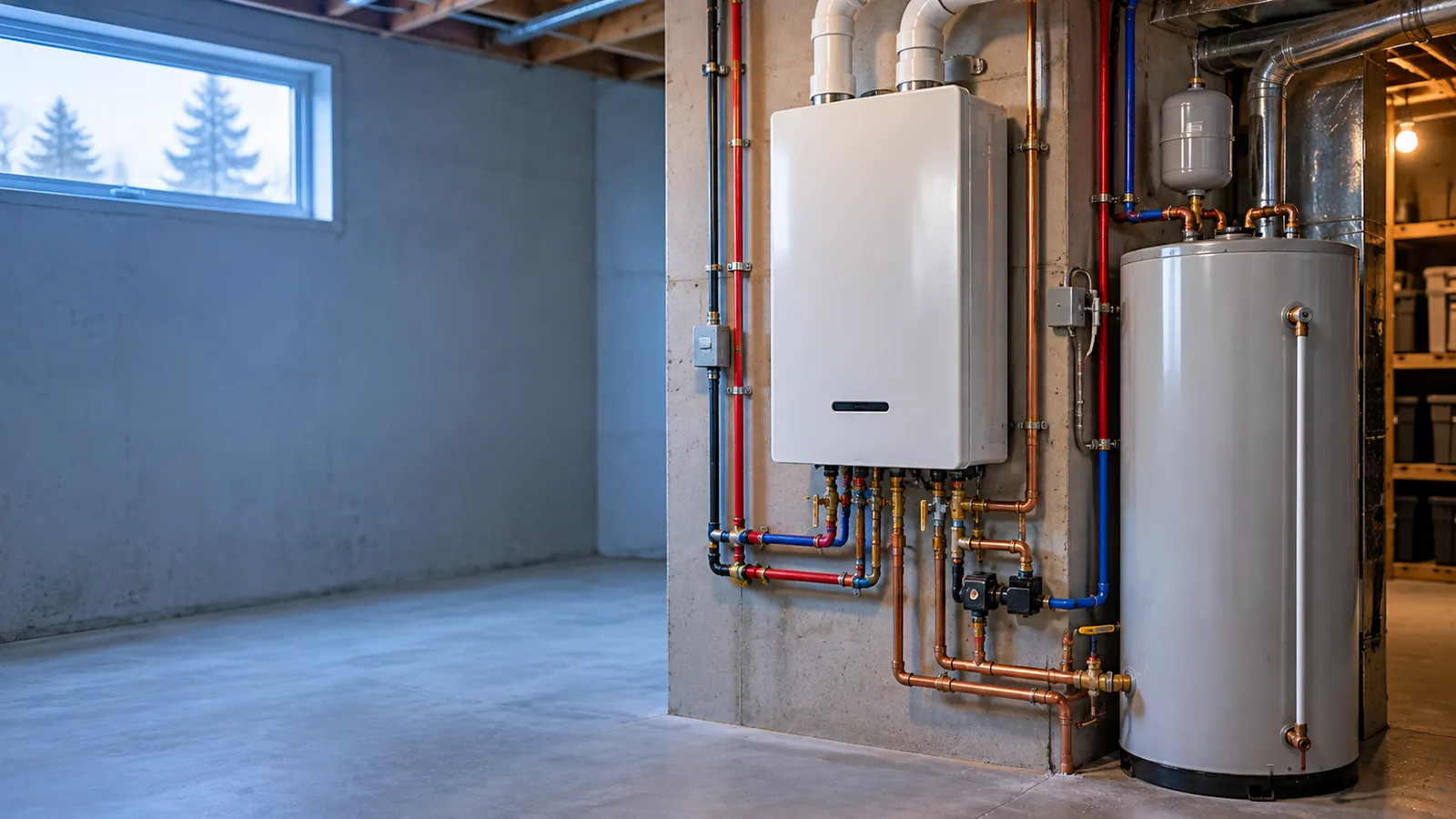
A tankless water heater heats water only as it flows, so it can give you hot water continuously and uses less energy on average, but it costs more upfront and can need changes to your gas supply and venting. A traditional tank costs less and is simpler to install and maintain, but it stores and keeps heating a tank of water and generally has a shorter life. Which fits your home depends on your household’s peak hot water use, your existing gas and venting, and your budget. A licensed plumber has to assess those.
- Natural Resources Canada says an ENERGY STAR certified tankless heater uses 30% less energy, on average, than a storage tank type.
- Rheem says traditional tanks typically last 8 to 12 years and tankless units 15 to 20+ years with proper care.
- Switching to tankless may mean a larger gas supply line and a different vent, according to Natural Resources Canada’s Water Heater Guide.
- Calgary’s hard water makes descaling a real maintenance task for tankless units.
In this article
- How do tankless and tank water heaters differ?
- Tankless vs tank: how do they compare?
- Is tankless more efficient?
- Does a tankless heater really give endless hot water?
- What does a tankless swap involve in an existing Calgary home?
- What are the honest drawbacks of tankless?
- What are the honest drawbacks of a tank?
- Which one should you choose?
- What three questions should you ask any installer?
- Next step
- Frequently asked questions
How do tankless and tank water heaters differ?
A storage tank heater keeps a tank of heated water ready. Natural Resources Canada describes it as the most commonly installed type in Canadian homes: a thermostat turns on the burner or element to keep the stored water at temperature, and cold water flows in to replace what you use.
A tankless (or on-demand) heater has no storage tank. It heats flowing water with either an electric element or a gas burner. NRCan notes it heats water only when needed, which removes the constant standby heat loss a tank has.
Tank types in Calgary homes. Our hot water tank page lists traditional, power vent, direct vent and tankless units. NRCan explains the venting differences:
- Conventional gas tanks use house air for combustion and vent through a chimney or vent.
- Power-vented tanks use a fan to push exhaust out a side wall and need electricity, so they cannot produce hot water in a power outage.
- Direct-vent (sealed combustion) tanks draw combustion air from outside and vent through the wall, and are more resistant to combustion spillage than conventional tanks.
Tankless vs tank: how do they compare?
| Criterion | Traditional tank | Tankless |
|---|---|---|
| Upfront cost | Lower (per our hot water tank page) | Higher (per our hot water tank page) |
| Energy use | Gas-fired storage tanks that earn ENERGY STAR use 14% less energy than a standard model on average (NRCan) | ENERGY STAR tankless use 30% less energy than a storage tank type on average (NRCan) |
| Lifespan | Typically 8 to 12 years (Rheem); 10 to 12 years (our table) | 15 to 20+ years with proper care (Rheem); 20+ years (our table) |
| Hot water supply | Limited by tank size and recovery | Described by NRCan as essentially endless hot water, limited by flow rate |
| Space | Floor space for the tank | No tank; gas models are usually mounted on an outside wall (NRCan) |
| Gas and venting | Existing setup often reusable | May need a larger gas supply and a different vent (NRCan) |
| Power outage | Conventional gas tanks can provide hot water (NRCan); power-vented cannot | Ask the manufacturer for your model |
| Hard-water upkeep | Flush the tank; check the anode rod (Rheem) | Descale the heat exchanger; Rheem says about every six months in hard-water areas |
We are not quoting installed prices for either type here. Our hot water tank page gives a range of $900 to $2,000+ for tank installation in Calgary, depending on size, type and complexity, and says a clear quote comes before work starts. We do not have a sourced Calgary price for tankless, so get a written quote that spells out gas and venting work. Our guide on what a hot water tank costs in Calgary goes through the price drivers.
Is tankless more efficient?
On average, yes. Natural Resources Canada’s ENERGY STAR page says certified tankless heaters use 30% less energy, on average, than a storage tank type. Its older Water Heater Guide (a 2012 revision) puts numbers on the efficiency rating (the energy factor, or EF): gas-fired tankless heaters rated from 0.64 to 0.98, averaging 0.85, against 0.53 to 0.70, averaging 0.62, for gas-fired storage tanks, based on September 2011 listings.
Two caveats. First, those are averages from a guide that is over a decade old, so check current ratings for any model you consider. Second, efficiency is not the same as savings in your house. NRCan makes the point that every appliance has two price tags: the purchase price and the operating cost. Its example is an electric tank where energy costs over 10 years run about seven times the equipment cost. The lesson is to compare operating cost along with price, using your own household’s hot water use.
Does a tankless heater really give endless hot water?
Not unlimited. NRCan’s ENERGY STAR page says a tankless unit can provide essentially endless hot water, because it heats as it flows. But the Water Heater Guide is clear about the limit: output is a flow rate, not a volume.
- Peak demand. If more than one shower or an appliance such as a dishwasher runs at once, those demands must be added and the unit must meet the peak.
- Cold incoming water. NRCan’s example: a unit that can deliver 15 litres per minute at an 18 degrees C inlet in summer delivers only about 11 litres per minute with a 5 degrees C inlet. The guide says winter intake water may be as cold as 5 degrees C, so choose with that in mind.
- Electric limits. Most electric on-demand heaters cannot supply an entire house, so they are rarely used that way in Canada.
For tank-based sizing, see our walk-through on what size hot water tank you need. NRCan’s own advice for tankless is to consult an experienced plumber to estimate your home’s hot water demands.
What does a tankless swap involve in an existing Calgary home?
This is where tankless decisions are usually won or lost. The heater is only part of the job.
Gas supply. NRCan’s guide says replacing a conventional tank with a gas tankless heater may require the gas supply to be increased, and gives a typical example of a 3/4-inch supply for a tankless unit compared with a 1/2-inch supply for a standard water heater. Sizing a gas line is licensed work, and we are not suggesting a size for your house.
Venting. The guide says gas-fired on-demand heaters are usually mounted on an outside wall so that flue gases can be vented through a side wall, and that building and combustion safety codes restrict where sidewall vents can go. It also says an evaluation by qualified service personnel is required when adding, removing or replacing any gas-fired equipment.
Permits. The City of Calgary says that in some cases replacing a hot water tank may require a permit, for example when changes involve upstream gas lines, the venting system or the type of water heater. Switching from tank to tankless can be all three. Our page on the topic is does Calgary require a permit to replace a hot water tank.
Hard water. The City describes Calgary’s water as hard because of calcium and magnesium, with 2025 hardness of 141 to 274 mg/L depending on supply and season. Rheem says mineral scale can build up inside a tankless unit’s heat exchanger, reducing heating efficiency and increasing wear, and that in hard-water areas you should plan to flush or descale about every six months. Natural Resources Canada more generally recommends servicing a tankless unit once every year or two by a qualified professional. Plan for descaling as a standing maintenance cost.
What are the honest drawbacks of tankless?
- Higher upfront cost. Our page says tankless costs more upfront.
- More installation work. A bigger gas line, side-wall venting and permits can add to the job.
- Electricity dependence. NRCan notes gas models that need electricity to operate cannot provide hot water in a power outage. Ask about your model.
- Maintenance. Descaling is more than a nice-to-have in a hard-water city.
- Capacity limits. Peak demand and cold winter inlet water can cut delivery below the number on the box.
What are the honest drawbacks of a tank?
- Standby heat loss. A tank keeps stored water hot all day, which NRCan identifies as the cost tankless eliminates.
- Shorter life. Rheem’s tank range is shorter than its tankless range.
- Running out. A tank holds a finite amount. NRCan advises judging capacity by first hour rating rather than tank size alone.
- Corrosion. The anode rod wears, and the tank rusts once it is gone. The details are in how long a hot water tank lasts.
- Floor space. The unit stands in your utility room.
Which one should you choose?
There is no universal winner, and the most useful framing is a set of situations, which are our own reasoning from the sources above rather than advice for your house.
- A tank tends to fit when your budget is the priority, your gas supply and venting suit it, and your household’s hot water use is moderate and predictable. Our page describes traditional tanks as lower cost and simpler to maintain.
- Tankless tends to fit when you value continuous hot water and lower energy use, have or can add the gas supply and venting, and will keep up with descaling. Our page describes tankless units as providing endless hot water and being more energy efficient.
- Neither is a good answer if nobody has checked your existing gas line, venting and permit requirements. Get that assessed first.
As our hot water tank page puts it, “We’ll help you choose based on your household size and budget.”
What three questions should you ask any installer?
- What will the gas line and venting work involve, and is it in the quote? A tankless swap can change both.
- What permits does this need, and who pulls them? Gas permits must be pulled by a licensed contractor unless the owner is a first- or second-class gasfitter, and the City says some replacements need a plumbing permit.
- What maintenance will this need in Calgary’s hard water, and what does it cost? Ask for descaling frequency, or anode and flushing needs for a tank, in writing.
Next step
If you are weighing the two, ask a licensed plumber to look at your gas line, venting and hot water habits before you pick a unit. H2O Expert Plumbing installs traditional, power vent, direct vent and tankless units through our hot water tank installation and repair in Calgary service, and gas line hook-ups are listed among our plumbing, gas and heating services. We are available 7 days a week. Get a free quote or call +1 (403) 700-4443. You can also read about our licensed Calgary plumbers.
Frequently asked questions
Is a tankless water heater worth it in Calgary?
It can be, but it depends on your home. Natural Resources Canada says certified tankless heaters use 30% less energy on average than storage tanks, and Rheem cites a longer lifespan. Against that, they cost more upfront and can need gas and venting changes, and Calgary’s hard water makes descaling important. A licensed plumber can assess your house.
Does a tankless water heater need a bigger gas line?
Possibly. Natural Resources Canada says replacing a conventional tank with a gas tankless heater may require the gas supply to be increased, giving a typical example of a 3/4-inch supply versus 1/2-inch for a standard heater. Gas line sizing is licensed work, so a qualified professional must assess your home.
How long does a tankless water heater last compared to a tank?
Rheem says traditional tanks typically last 8 to 12 years and tankless units 15 to 20 or more years with proper care. Our lifespan table lists 10 to 12 years for traditional tanks and 20 or more for tankless. Water quality and maintenance affect both, and Calgary’s water is hard.
Do tankless water heaters work in a power outage?
It depends on the model. Natural Resources Canada says gas-fired models that require electricity to operate cannot provide hot water during an outage, while conventional gas tanks can. Power-vented tanks also need electricity. Ask the manufacturer or your installer whether the specific unit you are considering works without power.
Do I need a permit to switch from a tank to a tankless water heater in Calgary?
Possibly. The City of Calgary says replacing a hot water tank may require a permit in some cases, including changes to upstream gas lines, venting or the water heater type. Gas permits must be pulled by a licensed contractor unless the owner is a first- or second-class gasfitter. Ask your installer what applies.
Sources
- Natural Resources Canada, Tankless water heaters (ENERGY STAR)
- Natural Resources Canada, Storage tank water heaters (ENERGY STAR)
- Natural Resources Canada, Water Heater Guide (revised October 2012; figures dated September 2011)
- Rheem, Water heater lifespan: when to repair vs. replace
- Rheem, How to keep your tank and tankless water heaters running at peak performance
- City of Calgary, Homeowner electrical and plumbing permits
- City of Calgary, Water quality, hardness and data
- City of Calgary, Carbon monoxide alarms
- H2O Expert Plumbing, Hot water tank installation and repair (client’s own page)