Should you repair or replace your furnace in Calgary? Repairing is usually the better choice for a newer furnace with a single fault, and replacing is usually better for an old furnace or an expensive repair. Two published rules of thumb point the same way: H2O Expert Plumbing’s furnace page says replacement is usually the smarter investment if your furnace is over 15 years old or repair costs exceed 50% of replacement cost, and a Canadian home-services price guide says repairs may be more cost-effective under 10 years old and replacement is often better when repairs exceed 50% of a new unit. Neither is a law, so this guide shows how to weigh age, repair cost, efficiency and safety for your own furnace.
- Repair when the furnace is relatively young and the fault is a single, affordable part.
- Replace when it is old, the repair is a large share of a new unit’s cost, or it keeps failing.
- Efficiency can tilt the decision: Natural Resources Canada gives an example in which a more efficient furnace cut annual energy costs by 18%.
- A technician’s written assessment of both options beats any rule of thumb.
In this article
- Repair vs replace: how do the criteria compare?
- How does age affect the decision?
- What does the 50% rule mean in practice?
- Does efficiency change the answer?
- Which is the safer option?
- What questions should I ask the technician?
- What happens once you decide?
- So which should you choose?
- Your next step
- Frequently asked questions
Repair vs replace: how do the criteria compare?
| Criterion | Points toward repair | Points toward replacement |
|---|---|---|
| Age | Under about 10 years (national price guide) | Over 15 years (the company’s furnace page) |
| Repair cost | Well under half the cost of a new unit | Over 50% of a new unit’s cost (both published rules) |
| Frequency of faults | A first or isolated fault | Repeated repairs in successive seasons |
| Parts | Parts readily available | Older furnaces may have limited parts availability (price guide) |
| Efficiency | Already a high-efficiency unit | Low-efficiency older unit, where savings may offset cost (Natural Resources Canada example) |
| Safety | Passed a recent professional inspection | A technician flags a safety concern |
Read the table as a set of signals, not a score, and note that no row on its own decides the question for your furnace. One strong signal, such as a safety concern, can outweigh several weaker ones.
How does age affect the decision?
Age is the easiest signal to check and the least precise. The company’s furnace page puts the threshold at 15 years or repair costs above 50% of replacement cost. A national home-services price guide, HomeStars, says repairs may be more cost-effective if a furnace is under 10 years old, and that older units may raise energy bills, which can make an upgrade more economical. That guide was updated on 21 August 2026, but it does not explain how its figures are derived.
Between 10 and 15 years, there is no published bright line. The decision rests on the next criteria: what failed, what it costs and how the furnace has behaved. The same price guide’s repair page notes that furnaces older than 15 years may have limited parts availability, which is a practical reason age matters beyond efficiency.
What does the 50% rule mean in practice?
It compares the quote to repair with the cost of a new installed furnace. If the repair costs more than half of what a replacement would, the rule says replacement is often the better use of money.
An illustration with made-up numbers, not a Calgary price: if a new installed furnace would cost $4,000, half is $2,000. A $700 repair on a 9-year-old furnace sits well below that line. A $2,300 repair on an 18-year-old furnace sits above it, and the furnace is also past the 15-year point, so both rules point to replacement.
For real figures to plug in, HomeStars lists basic furnace replacement, including installation, at $3,000 to $4,500+ and high-efficiency at $4,000 to $6,750+. Its repair page lists most single-component repairs at $200 to $600 and heat exchanger repair or replacement at $500 to $1,500+. These are national guide figures, not Calgary quotes; our guide to furnace repair costs in Calgary breaks down the repair side.
Does efficiency change the answer?
It can. Natural Resources Canada’s older guide, Heating with Gas (revised October 2012), gives an example: replacing a 20-year-old furnace with an AFUE of 78 percent with one that has an AFUE of 95 percent will reduce annual energy costs by 18 percent. AFUE, the Annual Fuel Utilization Efficiency, is the metric that expresses seasonal efficiency.
Today’s rules set a floor. Natural Resources Canada’s regulations page lists a minimum AFUE of 95% for gas furnaces without an integrated cooling component, for models manufactured on or after July 3, 2019, with lower minimums for some categories. That means a new furnace will generally be far more efficient than one built decades ago, though the actual savings depend on your home, your fuel costs and your usage. This article does not cover rebates or grants, because programs change; check the current official pages if you want to claim one.
Which is the safer option?
Safety is the one criterion where you should not wait for a rule of thumb. Health Canada says to have a professional inspect fuel-burning appliances at least once a year or in line with the manufacturer’s instructions, and to install a carbon monoxide alarm with battery backup. ATCO’s CO checklist lists a furnace among the appliances that can produce CO when operating improperly.
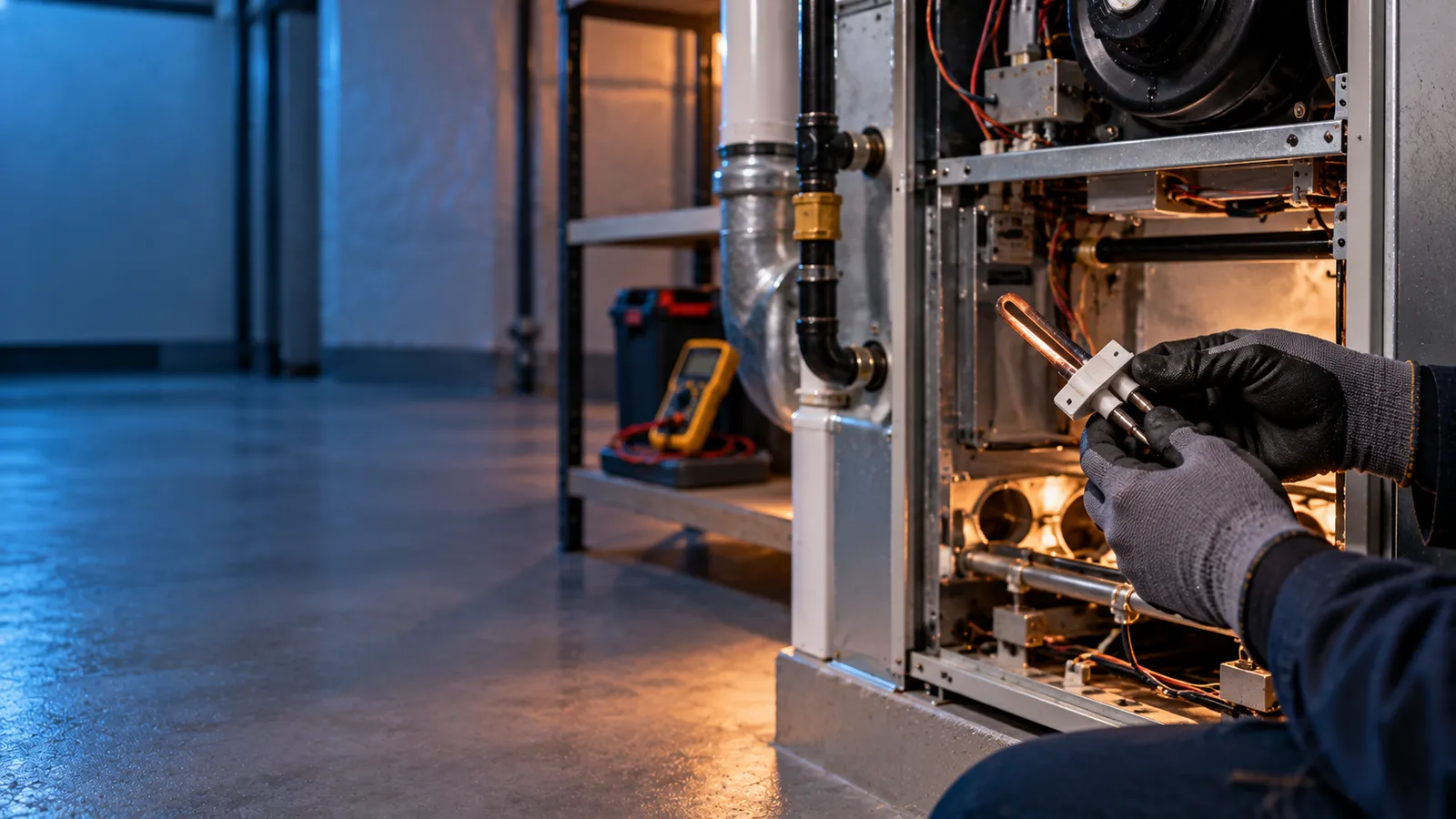
Natural Resources Canada says regular maintenance by a service professional should include inspecting the combustion and vent systems and checking the condition of the furnace heat exchanger. If a technician reports a problem with either, treat that as a safety finding, not a cost question. A furnace you cannot trust is not a bargain at any repair price.
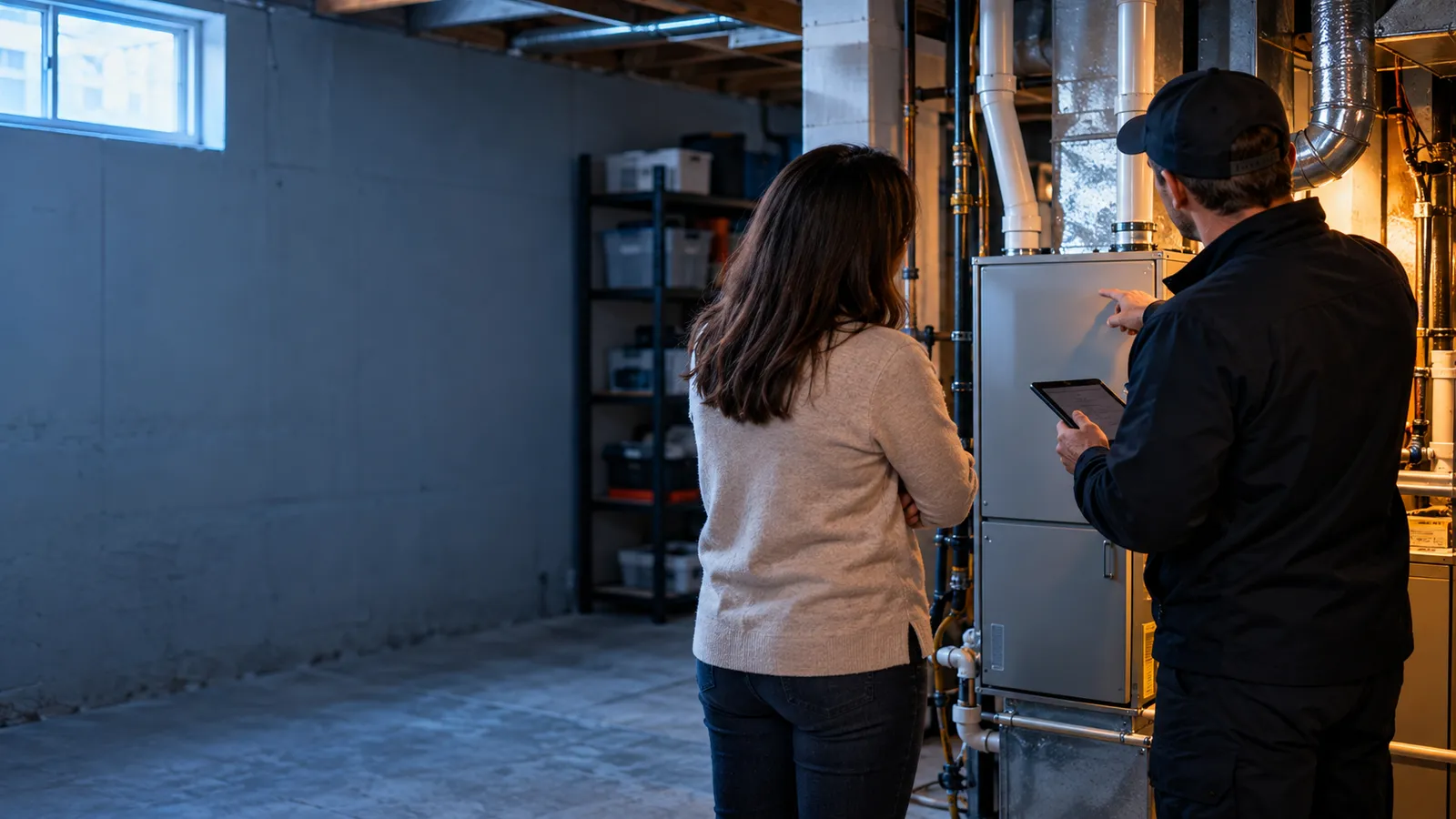
What questions should I ask the technician?
Ask the same questions whether you lean toward repair or replacement:
- What exactly has failed, and is it a single part or a pattern?
- Is the heat exchanger or the venting involved?
- What is the full cost of the repair, and what is the full installed cost of a replacement?
- How old is the furnace, and are parts still readily available?
- What size of furnace do you recommend, and how did you calculate it?
The fifth question comes from Natural Resources Canada, which says to ask a contractor for the calculation results behind the size and warns that a calculation based only on the floor area, or on replacing with an “equivalent” size, is not adequate in most cases. It also advises getting firm, written quotes from several companies for a complete new unit, including ductwork upgrades and disposal of old equipment.
What happens once you decide?
Whichever way you go, the process should be visible before money changes hands. The company’s furnace page describes four steps: inspect (assess the system, symptoms and safety requirements before recommending any fix), quote (a clear, upfront quote, with no work starting until you approve), repair or install, and test and confirm (verify performance and walk you through what was done).
For a replacement, the same page says the company installs all major furnace brands, including Carrier, Lennox, Trane, Bryant and Goodman, and recommends the best fit for your home and budget. That is a company statement about its own service, not an independent comparison of brands, so ask for the reasoning behind any model you are offered.
So which should you choose?
Lean toward repair if the furnace is under about 10 years old, the fault is a single part, the repair is well under half the cost of a new unit, and a technician has confirmed that the furnace is safe.
Lean toward replacement if it is over 15 years old, the repair is more than half the cost of a new unit, faults keep recurring, parts are hard to find, or a technician has flagged a safety concern.
Ask for both options in writing if you fall in between. A furnace that stopped heating is a stressful moment, and our guide on what to check when a furnace is not turning on can help you rule out the simple causes first. To avoid the repair-or-replace question in future, annual servicing helps you spot problems early.
Your next step
If your furnace is acting up and you are weighing the options, ask a licensed technician to assess it and give you the repair and replacement costs in writing. The company’s furnace page says its technicians will give you an honest assessment and that you receive a clear, upfront quote before any work begins. You can get a free quote or call +1 (403) 700-4443; the company is available 7 days a week. Its services list covers furnace tune-up, repair and replacement, and its about page describes a team of certified, licensed and insured professionals.
Frequently asked questions
How old is too old for a furnace?
There is no single legal age. The company’s furnace page says replacement is usually the smarter investment when a furnace is over 15 years old or repair costs exceed 50% of replacement cost, while a national price guide says repairs may be more cost-effective under 10 years. A technician’s inspection of your furnace matters more than age alone.
What is the 50% rule for furnaces?
It is a rule of thumb: if the cost of a repair is more than half the cost of a new, installed furnace, replacement is often the better use of money. Both the company’s page and a national price guide cite it. Get written quotes for both options before deciding.
Will a new furnace lower my heating bills?
Often, but it depends on your home and the furnace you have now. Natural Resources Canada gives an example in which replacing a 20-year-old, 78% AFUE furnace with a 95% AFUE unit reduced annual energy costs by 18 percent. Your own savings will vary, so ask the technician for an estimate.
Is it safe to keep running an old furnace?
Not if it has an unresolved safety problem. Health Canada says fuel-burning appliances should be professionally inspected at least once a year, and a CO alarm should be installed. If a technician finds a problem with combustion, venting or the heat exchanger, follow their advice before using the furnace again.
How long does a furnace replacement take?
H2O Expert Plumbing’s furnace page says most installations are completed in one day, and a standard replacement typically takes 4 to 8 hours depending on the unit and the existing setup. Your own timing depends on the home, so confirm it in your quote.